Back-Staining Troubleshooting Map: Indigo Redeposition Causes from Load to Final Rinse
Back-staining is rarely a single-point failure. In denim laundry, it usually builds across the batch: loose indigo releases during abrasion or enzyme treatment, stays suspended poorly, then redeposits on weft yarns, pockets, seams, labels, and high-contact folds before the final rinse clears the bath.
For a laundry manager, the problem is not only visual. Back-staining affects shade repeatability, cast, contrast, handfeel, rewash rate, and approval speed. This troubleshooting map gives your team a controlled way to isolate where indigo is being released, carried, and redeposited.
RivetTide supplies enzyme solutions for denim laundry teams that need predictable shade movement, cleaner contrast, and production-ready process control. If you are qualifying an enzyme supplier for denim washing, start with the failure map before changing chemistry.
Faceless explainer video: trace the redeposition path
The fast definition: what back-staining means on the floor
Back-staining is indigo redeposition onto areas that should stay clean, bright, or contrast-defined. It can show as:
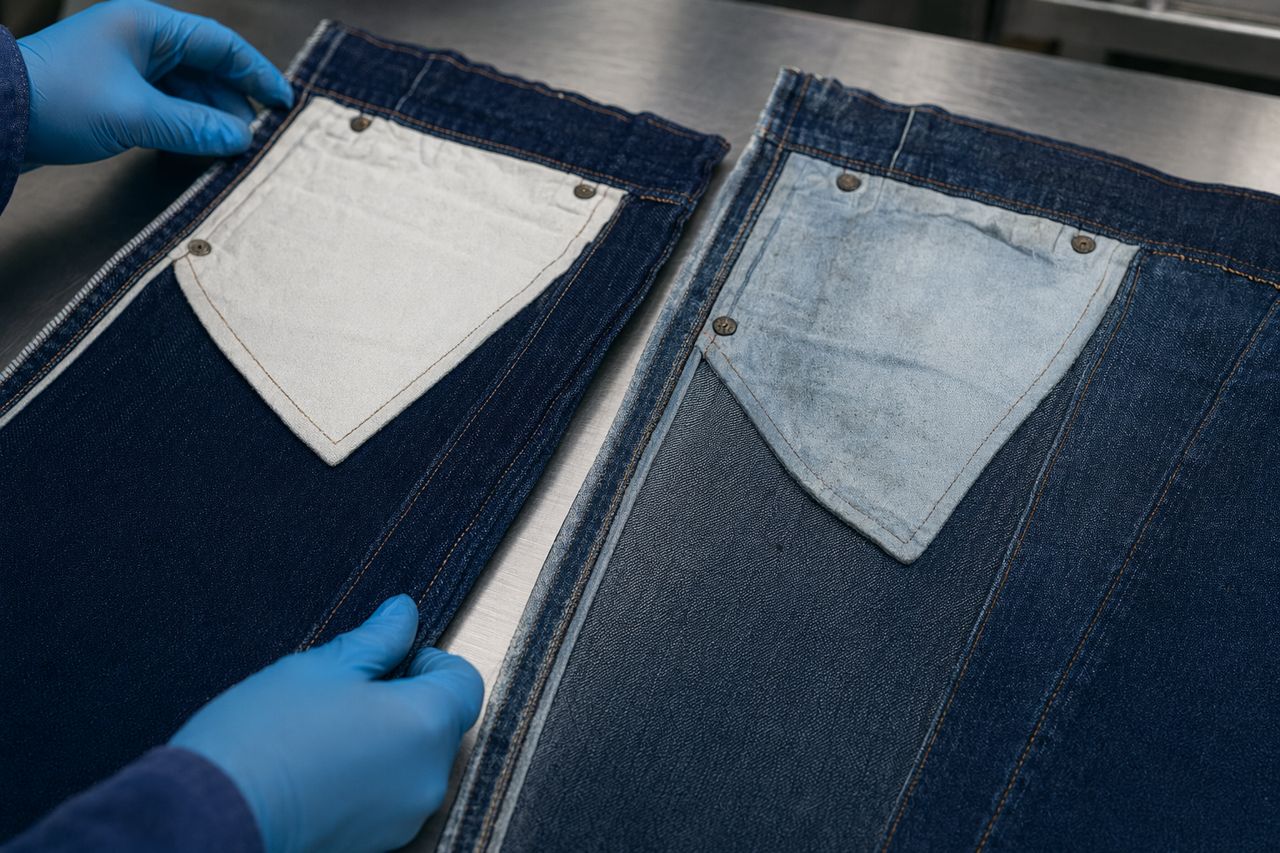
- Blue-grey cast on pocketing, labels, or weft face
- Muted whiskers and less separation in abrasion zones
- Dirty seam lines or edge contamination
- Uneven panel shade after rinse and extraction
- Batch-to-batch variation under the same recipe name
The key question is not “which chemical caused it?” The better question is: where did released indigo stop moving correctly?
Troubleshooting map: from load to final rinse
| Process point | What can go wrong | What to check on the floor | Correction direction |
|---|---|---|---|
| Load build | Overpacked or uneven garment distribution traps dye in folds | Drum fill, garment weight, wet-out behavior, dead zones | Reduce crowding, improve liquor movement, separate difficult styles |
| Wet-out | Dry pockets and tight seams absorb indigo-rich liquor late | First minutes of rotation, foam pattern, garment opening | Improve wet-out before abrasion or enzyme stage |
| Abrasion stage | Excess indigo release overloads the bath | Abrasion intensity, pumice condition, mechanical time, temperature drift | Reduce mechanical shock, sequence abrasion more cleanly |
| Enzyme stage | Surface opening is too aggressive or inconsistent | Shade drop speed, handfeel, contrast retention, lot-to-lot response | Adjust enzyme type, dose strategy, hold time, and temperature window |
| Bath control | Released indigo remains available for redeposition | Liquor clarity, foam stability, drain cleanliness, suspended lint | Improve dispersing support and rinse transition |
| Drain | Dirty liquor carries forward into rinse | Drain speed, sump condition, residual foam, garment hold-up | Drain completely before clean water entry |
| Rinse | Insufficient dilution leaves mobile indigo in contact with fabric | Rinse sequence, water exchange, rotation, temperature | Use staged rinsing and avoid weak first rinse conditions |
| Final softening | Contaminated bath can lock in dirty cast | Softener bath cleanliness, pH compatibility, residual color | Do not soften into a contaminated system |
1. Load build: the first redeposition risk
Back-staining often starts before chemistry has a chance to work correctly. If the load is too dense, garments cannot open, rotate, and exchange liquor consistently. Indigo released from one panel can stay trapped against another panel for too long.
Floor signs
- Random blue cast inside folds
- Heavy redeposition near pocket bags or inner seams
- Uneven shade within the same garment style
- Cleaner results in smaller pilot loads than in bulk production
Control move
Confirm whether the style is building dead zones. Heavy jackets, stretch denim, deep pockets, and dense seams may need different loading discipline than lightweight five-pocket jeans. Do not judge enzyme performance from an overloaded drum.
2. Wet-out: late saturation creates dirty contact points
If garments do not wet evenly, dry or semi-dry zones can absorb indigo-rich liquor after the bath is already loaded with released dye. This creates localized staining that looks like chemistry failure but is actually a liquor access issue.
Floor signs
- Staining concentrated around pockets, waistbands, and folded seams
- Inconsistent panel brightness after the same rinse cycle
- Foam channels that do not collapse evenly across the load
Control move
Stabilize wet-out before abrasion or enzyme action. Watch the first minutes of the cycle, not only the final shade. A cleaner start reduces the burden on anti-redeposition support later.
3. Abrasion stage: too much release, too fast
The abrasion step can release more indigo than the bath can safely carry. Aggressive mechanics, unstable stone behavior, or poorly controlled pumice-free systems can overload the liquor and reduce contrast clarity.
Floor signs
- Fast shade drop but dull contrast
- Blue cast on weft and pocketing
- Abrasion targets reached, but garment looks dirty rather than clean-faded
- More back-staining on high-mechanic recipes
Control move
Separate “abrasion target achieved” from “clean finish achieved.” If the bath is overloaded early, later rinsing may not fully restore brightness. Mechanical intensity and enzyme strategy should be balanced, not stacked blindly.
4. Enzyme stage: surface control without shade drift
A denim cellulase program should support controlled surface modification, clearer abrasion, and improved handfeel without pushing the shade beyond target. If enzyme action is too aggressive for the style, indigo release can accelerate and increase redeposition pressure.
Floor signs
- Good softness but excess blue cast
- Batch shade moves faster than expected
- Contrast is lower than the approved standard
- Stretch or lightweight goods respond differently from rigid denim
Control move
Review enzyme selection, dose discipline, hold time, bath temperature, and sequence. The right program should fit the plant’s operating window, not require fragile conditions that fail in bulk production.
RivetTide focuses on enzyme systems for denim washing where laundry teams need repeatable shade movement, abrasion support, and water-temperature flexibility across production styles.
5. Bath control: keep released indigo moving out, not back in
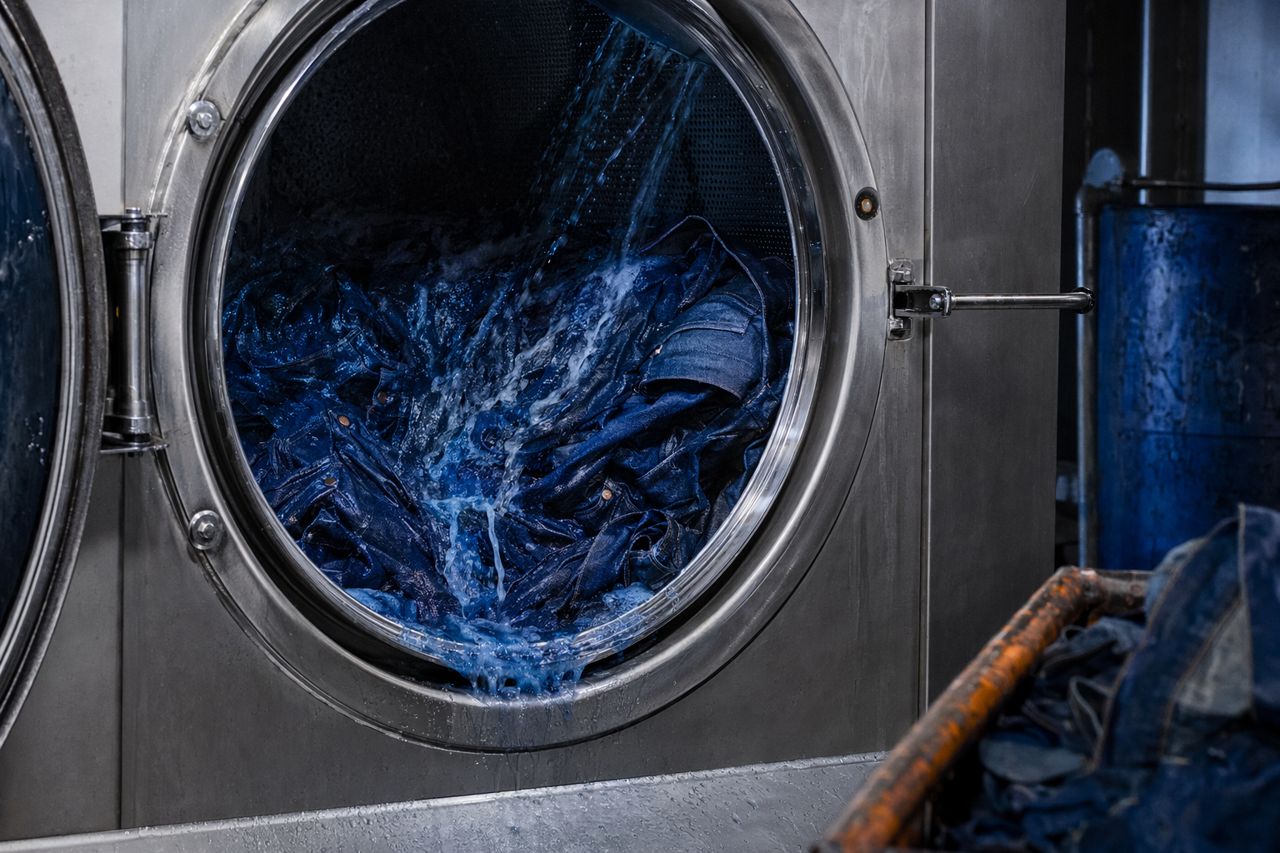
Once indigo is released, the bath must keep it from redepositing. If suspended solids, lint, foam, or dirty liquor remain in close contact with garments, back-staining risk rises quickly.
Floor signs
- Dirty-looking liquor late in the enzyme or abrasion stage
- Blue foam residue on glass or drum surfaces
- Lint or fine fiber carrying color through the process
- Cleaner shade after manual extra rinse, but not in standard cycle
Control move
Check the transition from treatment bath to rinse. Back-staining prevention depends on release control, suspension, drainage, and dilution working together.
6. Drain: the overlooked carryover point
A slow or incomplete drain can carry indigo-rich liquor into the first rinse. If clean water enters while dirty liquor remains trapped in the load or sump, the rinse starts compromised.
Floor signs
- First rinse already appears blue-heavy
- Staining varies by machine, not only recipe
- Similar recipe performs better on washers with cleaner drain behavior
Control move
Inspect drain timing, sump condition, and foam collapse. A clean drain is part of back-staining control, not just a utility detail.
7. Rinse sequence: dilution must be real
A rinse is not effective just because water entered the drum. Garments need movement, exchange, and enough separation from contaminated liquor. Weak first rinses are a common reason redeposition survives to final inspection.
Floor signs
- Pocketing remains blue-grey after final extract
- Contrast improves only after rewash
- Shade looks acceptable wet but dirtier after drying
Control move
Use staged dilution and confirm the first rinse is not simply recycling dirty contact. Temperature, rotation, and water exchange all affect how fast indigo leaves the garment system.
8. Final softening: do not lock in contamination
Softening should improve handfeel, not cover an unresolved rinse problem. If residual indigo remains in the bath, softening can make dirty cast harder to correct later.
Floor signs
- Handfeel is acceptable but cast is dull
- Rewash improves brightness but changes handfeel
- Final shade approval fails after drying, not before
Control move
Only soften after the bath is clean enough for the target finish. If the softener stage is becoming a stain-fixing stage, move back upstream and correct the release, drain, or rinse condition.
Practical plant-floor checks before changing the recipe
Use this sequence before making broad chemistry changes:
- Run the approved standard beside the problem batch if possible.
- Compare load weight, style mix, and garment construction.
- Observe wet-out and the first treatment minutes.
- Pull liquor observations at key transitions: after abrasion, before drain, after first rinse.
- Check whether shade drift appears before or after rinse.
- Compare machines if the issue is not recipe-wide.
- Change one variable at a time and retain panels for review.
This prevents the common loop of adding more correction chemistry while the true cause remains mechanical, drainage-related, or sequence-related.
When enzyme selection is part of the answer
Enzyme choice matters when the laundry needs cleaner abrasion, reduced back-staining pressure, softer handfeel, or better consistency across water-temperature variation. A suitable denim washing enzyme program should help the production team:
- Reach abrasion targets without excessive indigo release
- Maintain shade control across repeat batches
- Support cleaner contrast and less pocketing cast
- Reduce rewash caused by dirty appearance
- Fit realistic plant conditions and cycle timing
- Work with the laundry’s existing rinse and finishing sequence
The goal is not a more complicated recipe. The goal is a controlled recipe that operators can repeat.
Request a quote for a denim washing enzyme program
If back-staining is increasing rewash, slowing approvals, or making shade control unstable, RivetTide can help review the process map and recommend an enzyme direction for your denim laundry conditions.
Request a quote through the on-site form and include your garment type, target finish, current process sequence, water-temperature range, and the main back-staining symptom you need to correct.